


Who do you trust?
On what basis is trust created and what acts destroy it?
These are some of the central questions arising from the sense of distrust that people experience in dealing with the institutions that are supposed to govern and protect them.
Remove trust in your promise to repay a Treasury bond. What do you have? A worthless piece of paper.
Remove trust that you will keep your commitments under a trade agreement. What do you have? A worthless piece of paper.
Remove trust as the basis of reaching a ceasefire or peace agreement. What do you have? A continuation of war, a situation of endless war.
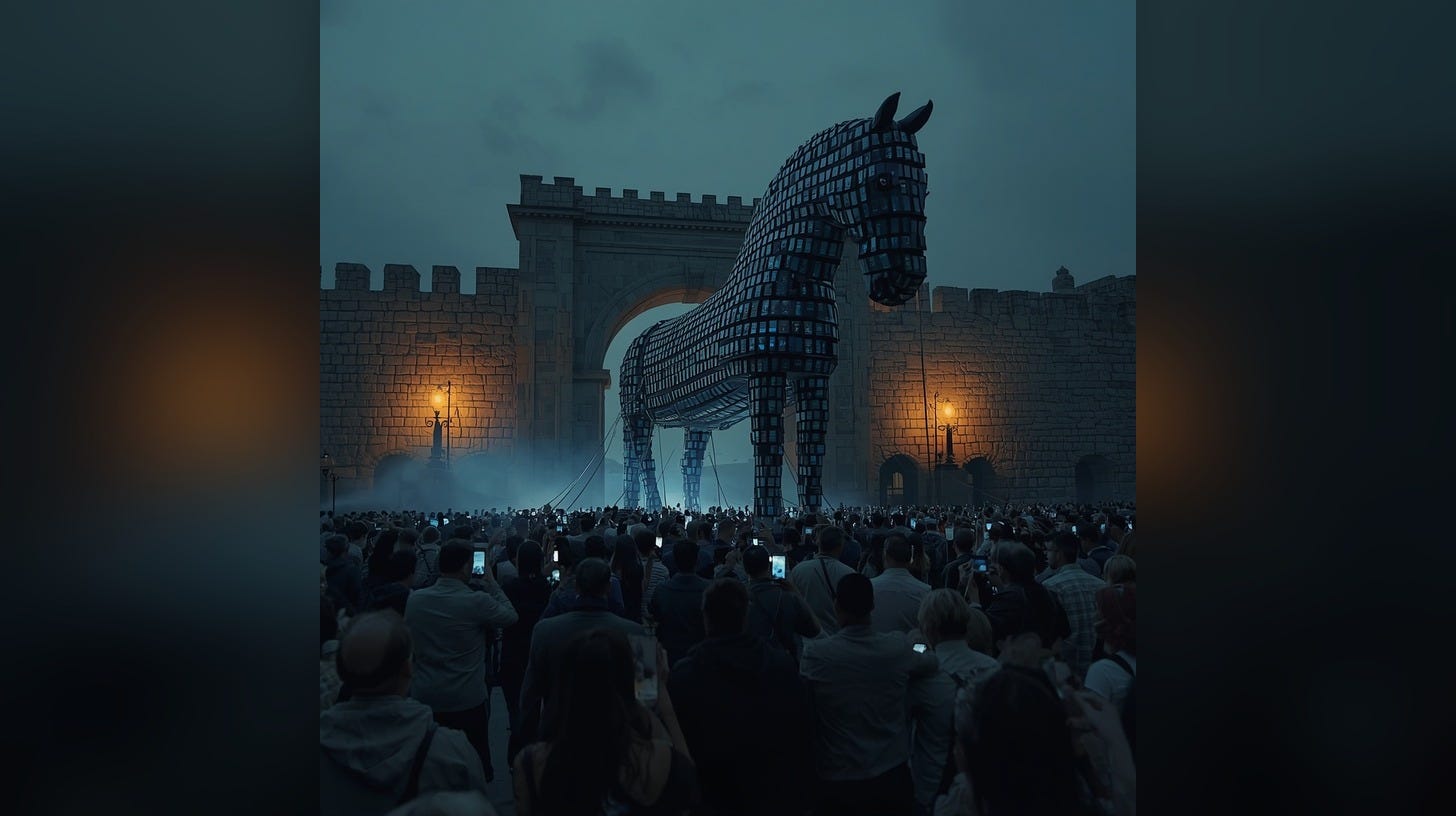
People are disappointed and angry. They are distrustful. Part of the explanation is that trust in government has been misplaced, left unchecked, and compromised by the self-interest of private corporations and government officials. Part of the explanation lies in the digital 24/7 information system where people’s opinions are manufactured and distributed through platforms they now ‘trust’ to tell them what is in their interest, who to support, and who to distrust. Instead of ‘your word is your bond’, we find people defending their ‘truth’ inside fractured communities. Faith in those truths over a consensus of whom to trust. We’ve realised that trust has shifted away from institutions to personalities who are ‘trusted’ to explain an action, a policy, a court decision or a law. That’s the Trojan horse. It appears like a gift, but once it is inside the gate we find that those hidden in it are the last people we can trust to work in our best interest.
How did American citizens allow themselves to drag the Trojan horse into their lives? Dwight Eisenhower warned them. Authors, op-ed commentators, YouTube interview videos, and public events and rallies preceding the election in 2024 rang the alarm bell and documented what was inside that horse. The urgency has accelerated in 2026. Yet millions failed or refused to listen. In the ancient Greek story, Laocoön warned the Trojans about the risk of bringing the horse through the city gates. They ignored him. Eisenhower is America’s Laocoön. Biden took up Laocoön’s baton, and his message ran into the same wall of disbelief or indifference.
What explains this grand failure of communication?
I suggest that instead of trusting in institutions, people have transferred trust to digital tribes they identify as reflecting their values, perspective and beliefs. Laocoön is filed as a member of an enemy tribe. He’s not one of us. We can’t trust him. Admittedly my evidence to support this statement is thin. One clue is that the place of reading (as in reading books) has been reduced. The truth-finding, trust-building of groups has migrated from books to memes.
The reading culture is gradually receding in our rearview mirror, and the road ahead, stretching to the horizon, is signposted with memes. The way we process information and make decisions is shaped by memes. Slick phrases and images that simulate depth. The shallowness of a slogan is our new baseline for detecting ‘the truth’ and ‘trust reinforcement’. Remember the Liz Truss lettuce, Dark Brandon, or Barbenheimer? They circulated widely on social media in the not-too-distant past, passing before millions of eyeballs for a flickering moment. A case can be made that these are punch lines to inside tribal jokes. I’d add that we trust those who make us laugh. Books engaged the logos, our logical, reasoning and analytical mind. Memes pull our emotions in directions that make us feel good. We trust those who make us feel good. We avoid those who question or challenge us to supply evidence for our position, beliefs, or opinion. To put things in perspective, should a future viewer stumble upon our memes the way we discovered the Chauvet horses, then the Liz Truss lettuce will be our horse on the cave wall.
If we can point to one moment when power on the way out spoke truth to a citizenry about the dangers ahead, it came from one man, Eisenhower, who inspired a sense of trust. He did something the powerful rarely do. He issued a warning. On the evening of 17 January 1961, the president who had commanded the Allied armies in the Second World War to victory in Europe sat before a television camera and warned the country that the institutions in which they placed their trust needed to be watched.
In those pre-meme days, Eisenhower found a phrase everyone still remembers, one that continues to circulate today. The military-industrial complex. That phrase has been reborn as a meme lost in the shuffle of thousands of memes. The reality of his warning, while never dated, occupies a back shelf in the library of our collective minds.
What has been overlooked is Eisenhower’s second warning in the same speech, a few paragraphs later. The second is a prophecy that came true. Ike cautioned the nation that public policy risked becoming the captive of a scientific-technological elite. During his time, the threat came from the federally funded scientist and the defence strategist. He would not have foreseen the rise of men like Elon Musk, who was born in 1971. Nor would he have anticipated the role of SpaceX (formed in 2002). What he saw was the outline of what was going to come and the shift of power that would follow.
Joe Biden, leaving the same office in January 2025, echoed Eisenhower. He labelled the danger as the tech-industrial complex. Two US presidents separated by sixty-four years resorted to slightly different phrases to issue effectively the same warning. Eisenhower spoke to our grandparents’ generation. They didn’t listen. Biden spoke to our generation. Will we listen?
We search for the right word or phrase to describe what Eisenhower foretold and Biden repeated. The reality is that the useful political discussion Eisenhower and, more recently, Biden invited must compete for attention in a noisy information ecology. The kind of deep attention required to follow the details of a complex realignment now underway is in short supply.
Where to start? One line of inquiry focuses on wealth accumulation and political influence.
Words like: “Plutocrat.” “Oligarch.” “Kleptocrat.”
The terms get thrown around as if they are fungible. That’s a category mistake. Plutocracy, oligarchy, and kleptocracy attach like barnacles to the American ship of state, exposed now as it lists. But none of these words is entirely accurate. The question gets framed as oligarchs against a would-be kleptocrat. That is not the contest. It masks something deeper. The contest is whether the state will subordinate capital, as Russia and China do in their different ways, or whether capital will keep operating through a state too fragmented to stop it. Trump is not standing outside that contest. He is one of its most active players, and his relationship to the tech billionaires is closer to symbiosis than to war.
“Kleptocrat” is an indictment. It names a ruler who steals, a regime that is a theft operation wearing the costume of state power. Scratch a kleptocracy and you find a criminal enterprise using the flag as a shield. Putin’s Russia answers to that description in important respects. The United States does not. Trump’s self-dealing is real. His family’s monetisation of the office is real. What is also real, and harder to indict, is that the federal government has not been reorganised around extraction as its central function.
A seasoned defence lawyer would argue that the charge of kleptocracy is wrong. The point being that a wrong charge loses a case that a right one might win. The real question is not whether Trump is a thief. It is whether the American state has lost the institutional capacity to stop private wealth from converting into public power. Checks and balances are how trust is built into the structure of the US political system. The message of the founders’ choice was simple: trust the system to stop the men and women from replacing that structure with a new system based on trusting them. We have witnessed incidents where those checks and balances have failed. What has been called into question are the structural guarantees that support public trust. Madison’s argument, based on “If men were angels…”, acknowledges that man needs protection against man. When structure is weakened or destroyed, all that is left to replace the object of trust is character. Madison understood something deeper about the limits of relying on character if for no other reason than that it personalised trust to an individual as a substitute for institutional structure.
That loss of capacity would be proved, if it could be proved, by a forensic reading of federal grants, contracts, regulations, executive orders, and the laws that are quietly being unwritten. A Congress that changes hands may yet go looking for that evidence.
The idea that Trump is an aspiring Putin misses how much he is a product of the configuration he is said to threaten. Musk, Thiel, Andreessen, Sacks. These men are not his rivals. Most of them financed the campaign, shaped the agenda, supplied the ideological framework. They filed into the administration, in person or through their protégés. Musk alone spent more than $290 million in the 2024 cycle, by the year-end filings. The relationship is not a duel. It is a trade. Trump needs their money, their communication channels and their reach. They need his regulatory relief, his contracts, and his willingness to dismantle the administrative state that fences them in. The friction is real. It is symbiosis trying to construct a hierarchy, and what we experience as instability is the conversion happening live, behind the screen of TikTok and Instagram, in what Guy Debord called The Society of the Spectacle.
The oligarch-against-kleptocrat frame is too coarse to hold any of this. Three distinctions do more work toward the goal of understanding this moment in time.
The first is between autonomous and subordinate plutocracy. American tech fortunes were built in markets and on government subsidy and contract. The federal government did not resort to a state privatisation of assets, which is the way the Russian fortunes were made in the 1990s. The American billionaire bought influence without being owned by what he bought. The Russian oligarch was autonomous for a single decade and then, in the Hemingway formula for going broke, gradually and then suddenly, he was not.
The second is that the American political instability we are witnessing is a sharing arrangement being renegotiated behind closed doors. Through DOGE, Musk led the charge, reaching deep inside the federal government’s databases. The DOGE unit was wound down in July 2026. Like a hungry anaconda, tech capital has also swallowed large parts of the regulatory and tax codes. The state, under Trump, is testing whether it can still discipline capital when discipline suits it. The Musk-Trump relationship was the experiment, and the public rupture between the two men proved temporary once they realised they needed each other for their own purposes and survival. By the autumn of 2026, in the run-up to the midterms, Musk became the largest known donor to Republican affiliated PACs and groups. He had unprecedented access. The access was always contingent on tolerance and utility. It’s unclear whether the oligarchs are equals at the table. The press treats Musk as a junior partner. He may be betting his fortunes on the probability that close proximity to power is safer than distance and independence from it. Whether the bet pays depends on whether an American president can build the coercive machinery Putin spent more than twenty years assembling. The American institutional landscape makes that far harder to accomplish.
The third distinction is the one that matters, and it belongs to Eisenhower. The Silicon Valley right is not a set of rich men buying favours. That is ordinary plutocracy, as old as the republic. This is a project to rebuild the state in the image of the firm. Faster. Less accountable. Organised around the people who own the infrastructure. It is easy to get distracted by the thought that Musk is an oligarch or Trump a kleptocrat. What matters is whether a state can agree on the boundary line at all between public authority and private platform as the two are in the process of merging.
A number of countries, including the US, seek to metabolise the same series of shocks against the institutional structures designed to instil trust. It hasn’t happened all at once. It is more a death by a thousand cuts. No one cut is fatal. But the institutions are in an ambulance on the way to intensive care. People are worried it is too late. Whether that is true is not obvious. What is clear is that the post-1945 order is failing everywhere. Each civilisation works to establish trust through institutions of its own. The problem is that once an institution fails to stand up against the personalisation of power, trust in its fairness and impartiality dies.
If trust is abandoned out of necessity, what is the substitute?
The strongman who personally inspires trust in a large enough share of the population to maintain power.
Russia runs the alternative trust system through the strongman. Putin built an apparatus that can discipline the rich, and the arrest of Khodorkovsky in 2003 taught every oligarch the lesson in a single afternoon. Keep the money, stay out of politics. Sanctions removed the exit. War supplied fresh plunder, with seized assets reaching more than two-fifths of the country’s merger-and-acquisition value in the first half of 2026, by the AK&M count. This is not a partnership. It is a hierarchy, and the oligarch holds his wealth at the sovereign’s pleasure.
China runs a post-trust system through the party. You might argue that the CCP is the institution that is the sole place where trust resides. What about the Chinese oligarchs? The constraint on Chinese capital is programmatic, not personal. When Alibaba grew large enough to look like a rival authority, the party corrected it, and the party’s message was delivered. Capital may flourish inside boundaries the party draws. The structural difference between Beijing and Washington is exact and worth a moment of reflection. In China the state is subordinating capital. In America the state is merging with it.
Iran runs it through the barracks. The Revolutionary Guard has grown from a militia into a state within the state, holding a large share of the economy and absorbing functions a civilian government is supposed to keep. In February 2026, a US-Israeli strike killed Ali Khamenei. The Guard, by most press accounts, chose his son to succeed him. The clerical institutions remain as façades, a Potemkin village with the real authority standing behind it, the barracks behind the mosque.
The role of AI is beyond the scope of this essay, but it is the shadow hanging over how the new structure is built. AI is the child of the tech oligarchs, who have a stake in the outcome.
The strongman, the party, the barracks, the merger. The merger is the American form. Eisenhower would have been familiar with the long arm of American history. The merger of corporate and state power is one of the oldest American patterns, running like a golden thread through the Gilded Age, the railroads, and the original military-industrial complex itself. None of this is novel in kind. What is new is the substrate. The state’s capacity is not only shrinking. It is being privatised and personalised. The terrifying possibility is that democratic institutions will no longer hold. Memes about accountability will flash across the screen. The new wine is being poured into old bottles, and the parable tells us what happens to the bottles.
I have written before about what happens inside a system when its central coordinating node loses capacity. The subsystems do not politely decentralise. They read the weakness as an opening and compete to become the new centre. In June 2023, Yevgeny Prigozhin’s private army seized the military headquarters in Rostov-on-Don and marched toward Moscow. Two months later, his plane fell out of the sky. What you get is not a flat chart. It is nested and overlapping hierarchies, some territorial, some functional, some personal, each claiming a piece of an authority that used to sit in one place.
That one place was sovereignty. The old definition was clean. A single actor, the state, holding the monopoly on legitimate force inside a border. That monopoly is now on the butcher’s block, carved along functional lines. Tech firms run the digital infrastructure and, increasingly, the military communications and targeting that ride on it. In 2022, Ukraine asked Elon Musk to extend Starlink coverage so its drones could reach the Russian fleet at Sevastopol. He said no. A private citizen made a decision in a war between two states. In October 2026 it happened again. Ukraine’s military link was throttled, and Musk justified his company’s decision to slow it because Ukraine had broken his terms of service. The same muscle flex, with its terms-of-service rationale, surfaced again that season. This time, to comply with an EU law, Anthropic had begun folding an invisible mark into every sentence that Claude, the name Anthropic gave its AI, had touched in the process of creation. The corporate decision happened in all countries at once, with no way to refuse Anthropic’s revised terms of service. Under that agreement, Anthropic had reserved the power to change, alter or revise its own terms of service without notice or consent of users.
Armies in some states have swallowed the economy. Strongmen have hollowed the checks and balances until each is the sole arbiter of who owns what. I wrote in a previous essay about the consent a surveillance state no longer troubles to ask of the public. This is the same story one storey up. The private platform no longer lobbies the sovereign. The lobbyists have disappeared into the sovereign, and the platform’s owners are becoming part of the governing structure with institutional power without the mantle of trust.
Lately the collective platforms increasingly need what historically a sovereign could offer. They are learning you can rule by writing an agreement that makes you an unchallenged ruler who lives inside the product, delivered worldwide the day it ships and revised afterward at the firm’s discretion. No chokepoints like a congress or parliament to persuade into passing a law, no building of civil servants inspecting, checking and auditing. All of that world is now passing away. If you want evidence, here’s exhibit A. In this case it isn’t what is present but what is missing in the terms of service agreement: an opt-out right for each and every customer. That’s your tell. By using that product, the only consent you give is to sign away your future consent to any new clause, even one that might cause your business significant harm. Part of this sense of loss of trust is a feeling that consent to important matters no longer matters. Under Madison’s fear is a modern one. A sizeable minority have been persuaded to turn away from the pre-existing democratic, economic, political and legal structure for a promise to trust a person with limited restraints on power. Trust the institutions. Don’t trust anyone’s character to act except in his self-interest.
Which takes me back to the words Eisenhower chose, and to the thing the conspiracy theories get backwards. “Complex” sounds like a plot. The deep state. The swamp. A hidden web with a hand on every string. I doubt that Eisenhower meant anything of the kind. He had his sights trained on a particular configuration. A set of incentives with a gravitational pull, visible to anyone who looks, authored by no one in particular and steering everyone. That is what we have. Not a cabal but a cascade. We are living under that waterfall. The assumptions the post-war world ran on have failed together. Trade would breed peace. Germany bought Russian gas for decades on that theory. The Nord Stream pipelines now lie ruptured on the floor of the Baltic. America would hold up the roof over the global institutions and trade systems. The cascade has washed away the old international architecture. In its place we find a much older system, where powerful states speak through kinetic force. The assumptions have evaporated like the morning fog, and in the clearer light we see how institutions that seemed so secure and stable have been hollowed out. States have fragmented from within before. That is an old lesson we are relearning. New claimants, corporate and military and personal, rush the vacancy.
Amitav Acharya has a name for the world this cascade leaves. He calls it a multiplex world, against the tidier word multipolar, which only counts great powers. A multiplex world has corporations and regional blocs and militias and platforms all acting at once, and no single actor able to settle an outcome across every domain. Trump can dismantle the order the United States built. What he can’t do is build the order that comes after. Putin can break his oligarchs with a strongman’s edict. What he can’t do is build a set of institutions that will endure after his tenure comes to an end. The Guard can seize a state. What it can’t do is make that state legitimate. Breaking previous institutions is the tactic each of them reaches for as they swing a sword. Building is beyond a strategy of swordplay. The irony is that the strongman model is all swordplay. Remove the strongman and another fills the role, or the strongman system collapses.
The bargains may be struck behind closed doors, but the web they produce, filled with intrigues, force, and threats, is not hidden. We see the flash of the strongman’s sword daily. It is not hidden behind the curtain. It is staring back at us in daylight, a tangle of competing claims that no single hand controls. The fight over that sword is for all to see. If there is a peace treaty, will we be left out?
Eisenhower did not end his warning in despair. He saw what was coming. He had seen the battlefields of the dead. He had more cause for despair than we do. He ended his warning on the only instrument he trusted. An alert and knowledgeable citizenry, he said, was the one force that could compel the huge industrial and military machinery to mesh with peaceful methods and goals, so that security and liberty might prosper together. He meant a citizenry committed to working inside trusted institutions. Ike placed his faith in the capacity to see clearly and to say plainly what one sees. That is the very thing memes distract us from seeing and pushing back against. Carried into our moment, that faith is in the human capacity to stand without fear, and in the courage to challenge the strongman or the oligarchs who share his platform. Soon we will know whether this faith can be rekindled.
Last week I published an essay titled The Time Capsule. I argued that the horses painted on the walls of the Chauvet cave 36,000 years ago must be read in the language of that time. So must this writing on our cave wall. The reorganisation of the world is a kind of writing, and it can be read by anyone patient enough to learn the warnings of the limits of public trust and stubborn enough to say in the language of meme: we resist, we rebuild, we recover our agency. Yes, I see the irony. I recognise we live in the land of slogans while we strive toward a future we do not and cannot know. We communicate in the medium of our time. As the art in Chauvet shows, the medium of communication and the tools used in that medium change.
And 36,000 years from now, if we remain, our time and our struggle will be compressed into a single frame in a long film.
A reader then will likely use alien tools working on a different medium of communication to extract meaning and intention. When they come to our era, they will experience what we felt looking at the cave paintings. The warning left behind in 1961 was clear. Breaking trust is no small thing. The trust-breaking complex Eisenhower saw coming is here. It is legible, and being legible it is not yet fate.
In the winter Eisenhower gave his farewell address, Johnny Carson was hosting a daytime game show on ABC called Who Do You Trust? A husband was asked a question and had to decide whether to answer it himself or trust his wife to answer for him. It was played for laughs. Madison faced the same question in 1788, and nobody laughed. Men are not angels, so no one can be trusted to answer for everyone. The strongman makes Carson’s offer without the laughter: trust me to answer for you. Eisenhower’s alert and knowledgeable citizenry is the contestant who chooses to answer for himself. What is at stake is not a game. It is not a show. Neither is it entertainment. It is the serious business of reinventing democracy on a foundation of trust.