

The War Over Reality
The courtroom, the corpus, and the procedure we stopped trusting

America’s deepest conflict may not be political, economic, racial, or cultural. It may be epistemological. The country is divided less over what people believe than over how a belief earns the right to be trusted.
One side asks what the evidence shows. The other asks what feels true, or who speaks for people like them. Each treats the other’s question as a symptom. The evidence camp sees ignorance. The experience camp sees a priesthood guarding its rents. Both are partly right. That is what makes the quarrel so hard to end.
The usual diagnosis stops there. Two tribes, two sets of facts, no shared ground. I want to push past it, because the usual diagnosis misnames the loss. The country has not lost its agreement about reality. It never held that agreement. What it has lost is narrower and far more dangerous. It has lost faith in the institutions and procedures that once let people disagree about reality and still be bound by a common result.
I spent years teaching and practicing law before my first novel was published. The law taught me the thing the current panic keeps missing.
A trial or a negotiation is not a search for truth. I have told clients so, the ones who arrived expecting one. The court makes no promise to find what happened. It promises a result that both sides agreed in advance to accept. The agreement is everything. Twelve strangers who share no politics, no faith, no class file into a room and return a verdict. They do not first agree on reality. They agree on rules. What may be heard. What may not. Who carries the burden, and the weight of the burden.
The common law traditionally prices its own uncertainty. A civil claim turns on the preponderance of the evidence, a hair past even. The graver wrongs ask for proof clear and convincing. A criminal conviction demands proof beyond a reasonable doubt, because a society decided the cost of caging an innocent man should sit higher than the cost of freeing a guilty one. None of those are facts about the world. They are decisions about how wrong we are willing to be, and in which direction. The system holds because people accept the calibration after they lose, not only after they win.
The clearest proof is a case everyone remembers. In 1995 a criminal jury acquitted O.J. Simpson. Two years later a civil jury, weighing the same death, found him liable and ordered him to pay. Same man. Same facts. Opposite results. Neither verdict was a lie. They ran under different standards of proof, and the country accepted both, because the country still trusted the procedure that produced them. That is the machine working as designed. The result tracks the rules, not the truth, and the loser stays in the room.
So the American fight is not really about facts. Facts have always been contested. It is about whether the procedures for settling contests still command respect. The peer-reviewed study. The audited account. The recount. The correction. The appeal. Each is a courthouse of a kind. Each asks the loser to honour the result and stay in the room. The crisis is the swelling number of people, on every side, who will not.
This also clears up something the evidence camp gets wrong about itself. The expert is rarely the person most certain of the truth. He is the one most comfortable holding a belief he expects to lose. The physicist knows general relativity may be bent by the next measurement. He trusts the procedure, not the verdict it last returned. The man who says this just feels true to me is no more certain than the scientist. He has pledged loyalty to a different court, one whose only judge is himself, one that hears no appeal. The difference between the camps is not heat against cool reason. It is which court each agrees to be bound by, and whether that court can ever rule against them.
The experience camp did not conjure its suspicion from spite. The institutions handed it the grounds. The study that would not replicate. The official who reversed himself in a season and never explained the reversal. The newspaper that buried its corrections and led with its errors. Trust in a procedure is not a mood ring. It is a record. When the keepers of a procedure shield themselves before they honour the result, the watching public learns the lesson and applies it everywhere, including where the procedure was sound. One rigged trial buys the disbelief of a thousand fair ones.
There is a parochial flinch in the way all this gets discussed, and I felt it leave me only by living elsewhere. I write from Bangkok. The frame of evidence against feeling, reason against emotion, is not a map of the human mind. The frame is a local inheritance, post-Enlightenment and Western, and it was never the only working arrangement.
A Thai dispute often does not hunt for who is right. It hunts for what keeps the relationship whole and the senior party unshamed. Face is not a flaw in the procedure. Face is the procedure. The Chinese tradition spent two thousand years preferring mediation to judgment, on the Confucian instinct that a society which runs to court is already coming apart. These are not gentler editions of the Western trial. They are rival answers to the one question every society must answer. How do we end a quarrel without ending each other.
From here the American emergency looks less like the fall of Rome and more like a late and painful discovery. The consensus that broke was always local. It felt like reality because no one in the room had ever stood outside it. A culture learning that its settled procedure was contingent has not watched knowledge die. It has met, at last, the ordinary condition of every other culture on earth.
Bring the machines in now, because this is where the fight changes shape, and where both camps have misread what they face.
The standard story casts AI as the common enemy. The scientist fears a rival that reasons with no Nobel to chase. The skeptic fears one more expert built to overrule his gut. For once, the story goes, the two sides face the same way. The truce will not hold, and the machine is not playing the part assigned to it.
A large model runs neither operating system. It does something stranger. It hands down the verdict without the trial.
Ask it anything. The answer arrives in the voice of a court. Measured, reasoned, sure. It carries the cadence of a ruling that already survived its appeal. What it omits is everything that ever gave a ruling weight. No rules of admissibility. No burden assigned. No standard of proof named. No losing party in the room with a right to be heard again. The form of judgment comes stripped of the procedure that made judgment binding, and it reaches a reader who has lost the habit of asking what a verdict is supposed to cost.
Watch it happen. A parent types a question about a treatment for a sick child. Back comes a paragraph, balanced, sourced, calm, the studies weighed and the caveats placed. It reads like a finding. The parent takes it as one. No court sat. No one cross-examined the studies for this child. No burden was carried. The fluency did the work a trial used to do, and the parent never saw the substitution.
Here the courtroom returns from the side neither camp was watching.
The evidence camp believed it wanted rigour. Mostly it wanted to win the argument and be finished. The experience camp believed it wanted to be heard. Mostly it wanted an authority that would not condescend. The machine hands each of them the prize without the price. The scientist gets a confident answer faster than peer review could dream of producing. The skeptic gets a patient voice that never sneers and seems to know him by name. Neither sits through the trial. Neither risks the loss. Neither side wins the war over reality. Both outsource it to a system that issues rulings and keeps no court.
This is the friction both camps spent years trying to flee. A trial is slow on purpose. Cross-examination is friction. The burden of proof is friction. The appeal is friction. Each is the deliberate cost a society pays so the loser will honour the result. Remove the friction and faster justice is not what you get. You get the look of a verdict with nothing beneath it. A ruling that binds no one, because no one agreed in advance to be bound.
So the question was never whether emotion or reason should rule. A human being needs both. Emotion supplies the motive. Reason disciplines the judgment. The real question is whether a people can still bind themselves to a procedure whose result they might lose.
That binding is the whole of the thing. Not consensus about reality, which no society has held and none requires. The narrower covenant. To argue under rules. To accept the result. To stay in the room after losing. Twelve strangers manage it on a Tuesday afternoon, agreeing on nothing but the rules. A nation that forgets the trick is not marching toward one tribe’s victory over the other. It is drifting toward a country where every quarrel runs to its own court, each court finds for its own side, and no result can bind a soul who did not already agree with it.
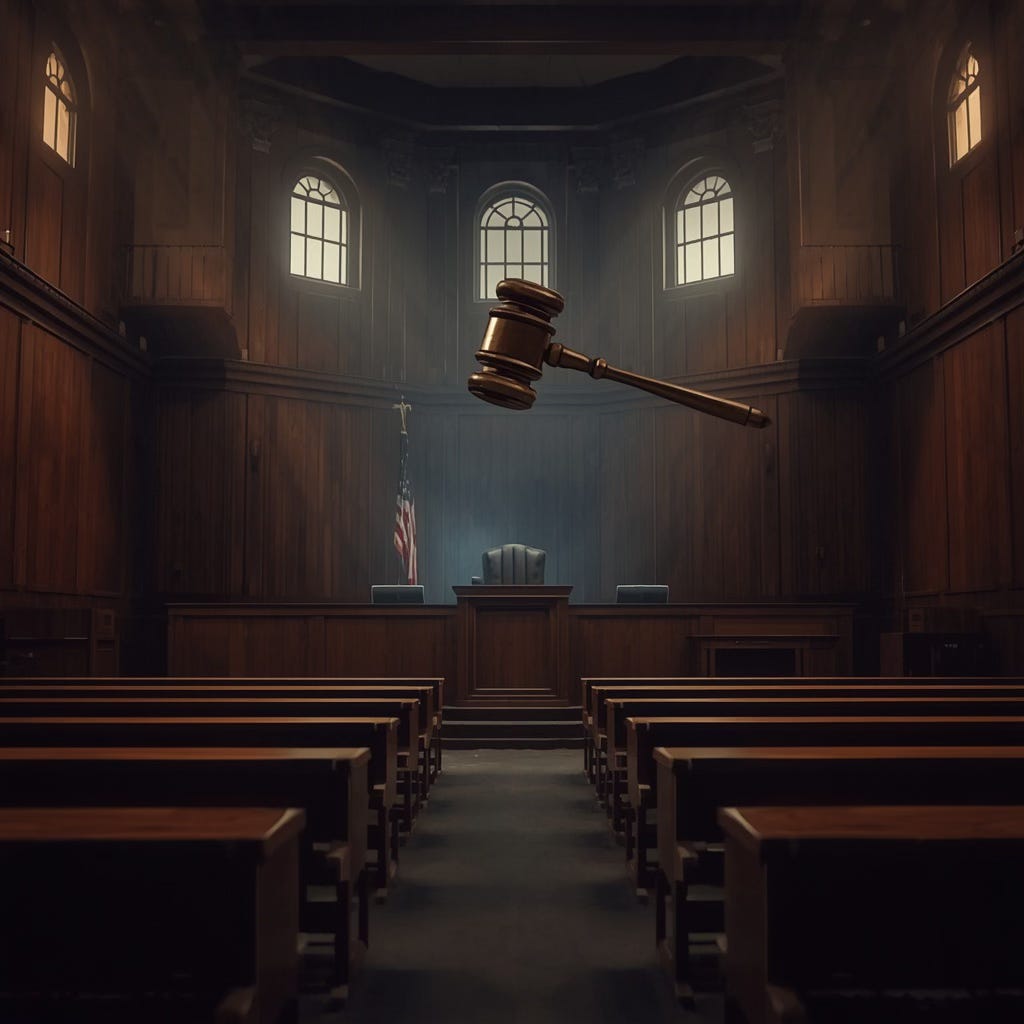
A machine that issues rulings and holds no trial will feel, for a while, like rescue from all that friction. It is the reverse. It is the courthouse with the trial torn out and the gavel left swinging. The verdict still sounds. The procedure that made the sound mean anything is gone. A people who forget what the friction was for will not feel the loss until the day they need a result the other side will honour, and discover that no such result can be made any longer.
Christopher G. Moore is the author of the Vincent Calvino crime series and most recently The Client That Wasn’t There (Heaven Lake Press, 2026). He writes on AI, culture, and creativity.
Dave, thanks for this. The 70/20/10 breakdown is a sharp way to frame it and I can see why the essay reads that way. But I want to gently push back on one thing, because I think the scarier part is not the scenario you are describing.
Your model has overlords issuing orders and people sorting themselves into comply or resist. That is coercion. What I am trying to get at is something quieter and harder to fight. Nobody has to be ordered. The machine does not command. It answers. And it answers so fluently, so calmly, in a voice that sounds like a ruling that already survived its appeal, that the person asking never thinks to ask the questions that used to matter. What standard of proof applied here? How good was the evidence? Who carried the burden? And if I think this answer is wrong, where do I take my appeal?
That is why the courtroom metaphor carries weight for me. A trial is slow and adversarial on purpose. That friction is not a flaw. It is the price a society pays so the loser will honour the result. Strip it out and you do not get overlords forcing compliance. You get people volunteering it, freely, because nothing in the experience reminded them a verdict was being handed down at all.
The mass formation link is worth reading. I would just say the essay is pointing at a different layer. Not crowd psychology but structural legitimacy. What makes any result trustworthy enough that the side that lost will stay in the room? That question survives even when there is no crowd and no overlord. Just one person, one machine, and an answer that never felt like a ruling.
“A pound of that same merchant’s flesh is thine, The court awards it and the law doth give it.”