


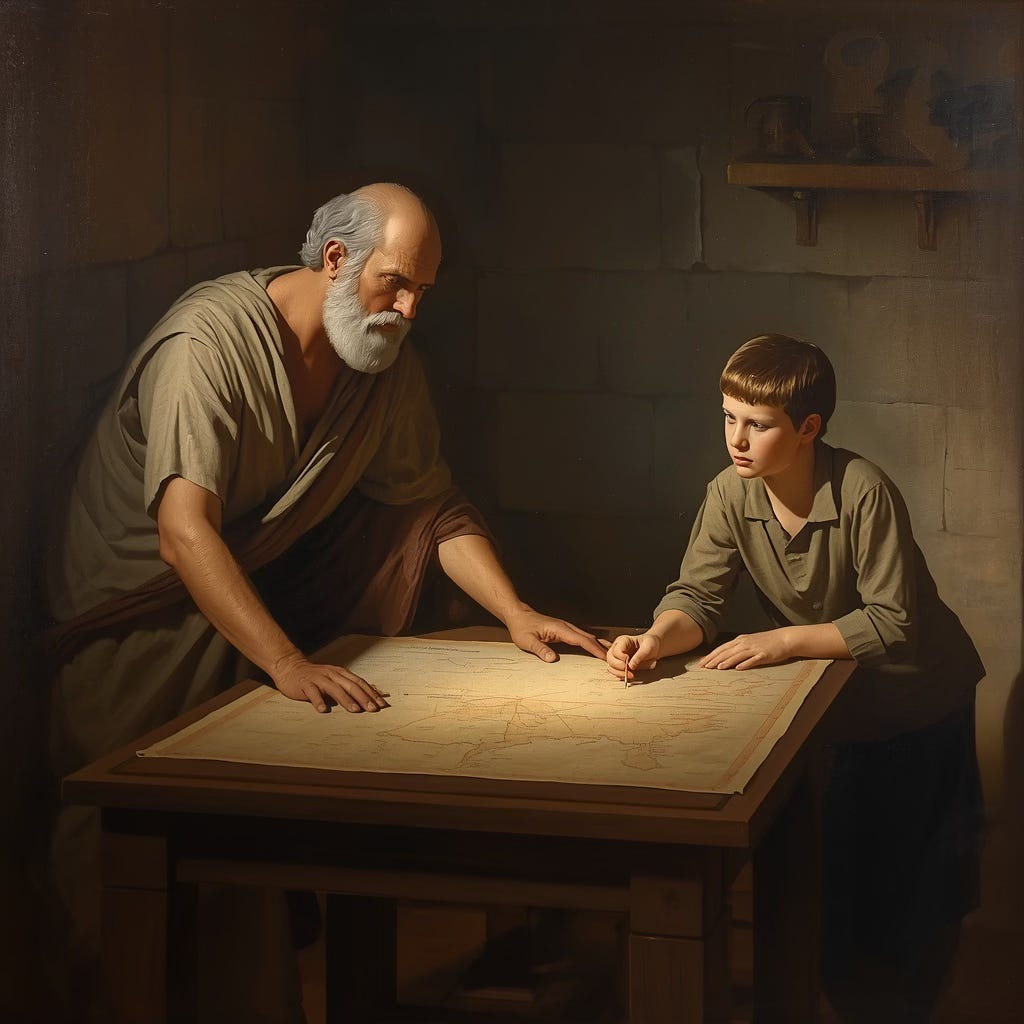
You don’t need an expensive online course to learn the framework that holds fiction together. Aristotle tutored Alexander. Alexander went out and conquered physical territory. A writer conquers a different kind. The psychological ground where the reader lives. If you want the strategy to take that ground, a wise tutor like Aristotle will equip you to write the novel that conquers it.
AI is the punching bag of the season. Everyone takes a swing. Most punches don’t land. The reason is that craft has slipped in the league standings, from the first division to the second. This essay argues that is a mistake.
The Sandbox
Start with a sandbox, climb inside and play: with ideas, context, characters, objects and things in a place, and be open to the voices of your characters especially when those voices are saying things you disagree with. The purpose of a sandbox is to find patterns, observe what is said and compare with what is done by a character, and assemble a community of relationships that experiences friction through first-hand experience. This is incubation stage. No AI will have the range of your first-hand experiences to draw on. Everything an AI brings is borrowed. If you want readers to buy into your story, you have to give them the feeling of ownership. Don’t get discouraged that the prose is flawed, the ideas half formed, the characters do unlikeable things, hold opinions and beliefs that conflict with your own. See this time as precious.
Stay away from AI when you are in the sandbox phase? Why would I do that? Because an AI is trained to smooth out the flaws, the contradictions, the ambiguity, the rough patches, substituting a generic word for a specific word that came to you in a flash. Introducing an AI at this stage will strip away your voice. And in its place leave a generic, educated, persuasive, flawless prose that will impress you. But it isn’t you. It’s database everyone’s prose. Treat every line in an AI return as from someone else. Don’t delude yourself into thinking it is yours.
Once in the sandbox, that is when you invite Aristotle inside.
The Three Buckets
Aristotle has three buckets for you to examine. First, a quick summary. Aristotle named three ways a piece of writing persuades a reader. These determine whether a book survives a season or floats to the bottom. Out of sight. Forgotten. The first bucket is Logos. It is the argument, the reasoning, the structure. Next is Ethos. It is the credibility of the writer to tell the story, the authority of characters to act and react inside the story, and once established, the writer has earned the right, the reader’s decision to be believed. The last bucket is Pathos. It is the feeling the story stirs in the emotions of a reader. Anger, regret, frustration, disappointment, hate, love, empathy roll out of the sandbox, or do they roll out of you, as you are also a reader.
Notice what two of the three quietly demand. A self. Pathos needs someone to feel it. Ethos needs someone to answer for it. Logos needs no one home. Hold that thought. We come back to it.
Hold these three buckets and you are going to use a small plastic shovel to scoop out grains from each bucket and seek to understand how this structure is the spine of your story. The whole quarrel between human and machine writing is misplaced. In one way it is the polished prose drawn from training data. You appear in public in a dinner jacket, presenting it as if you had hand-tailored it yourself. You didn’t. The greater problem for the fiction writer is thinking AI is a sandbox experience in the same way of a writer working alone in his or her sandbox. AI isn’t Aristotle. It wishes nothing. It is optimized to keep you happy. Unless you ask it to red-team your work, it will call every half-formed, incoherent idea brilliant. It is more like digital soma, Huxley’s drug of contentment, than a tutor. It pretends that what it delivers came from your own imagination. It’s a seductive lie. But seduction doesn’t convert a lie into truth.
One Bucket at a Time
Pathos. AI can already manufacture the effect of feeling. What it cannot do is experience the thing itself. It has never watched someone it was arguing with grind their teeth, flex their jaw, clench their fists, or blush a traffic-light shade of red. By its nature an AI can only draw on its training data to simulate the experience the inquiry calls for. It matches your expectation and assembles the best explanation, and the surface looks like lived experience. It isn’t. Nothing was lived. In reality, an AI will write a eulogy that wets the eye. You stick your name on it and claim the tear belongs to you. No it doesn’t. That tear belongs to a machine. So the real question is not whether AI can move a reader. It can. The question is whether there is pathos when no one feels anything at the writing and transmission end. If you’ve read AI-written prose, you recognize the “uncanny valley” feeling of revulsion that wells up. The simulated machine-driven tear is not human. You see that you’re being manipulated. This is where the experience clone from my essay last week, The Substack Hunger Game, arrives. https://tinyurl.com/ycy5wvm3
We have an instinctive negative feeling when a clone writes a eulogy rather than one written by a close friend of the deceased with all the tiny tics and flaws that we recognize as human. The AI cloned emotion registers on many who mistake the cloned version for the human one. One rule of thumb (or at least it should be one) is don’t write a eulogy about someone you didn’t know. It is the feelings of that human relationship that make the mourners feel something. That person had skin in the game. AI has none. When we spot the counterfeit affect, we feel cheated. Readers don’t want to be moved by words written by a machine that feels nothing, never knew the deceased, never saw him smile, walk, or talk about sports or politics. None of that will arrive from text written by an AI.
A grade five student in an upcountry school near a river in rural Thailand. She is with her teacher when she spots a mud-stained red flag fluttering on a pole in the distance. When the red flag flies it means that the air is dangerous. The eleven-year-old student looks at the stain on the flag and then at her teacher, asking, “Is the air bad?” The teacher nods. The student then looks at the bottle of water in her own hand. Then she asks: “And the water?” That sequence is pathos at its most efficient. The girl does not understand what she is asking. The reader understands everything she is not asking. That gap between the child’s innocence and the reader’s knowledge is where the emotion lives, and the writer did not put it there by explaining it. The writer put it there by juxtaposing three images: stain, flag, bottle in the girl’s hand. The reader makes the connection. The event of the flood leaving a trail on a nearby flag that even an eleven-year-old can follow registers an emotional reaction in the reader. It is this feeling experienced by the reader at the end that leaves a mark. The feeling is assembled by the reader from the event. The little girl in the story asks her teacher whether the air is bad.
The ending confirms it. From a distance the flag is simply red. Only when the wind turns the cloth can the stain be seen. That is pathos serving logos: the reader feels the whole argument in one image, and the argument is never named.
Do you laugh, sigh, cry when a character in your story is doing something you didn’t expect?
Ethos. Ethos is credibility that a real, mortal, accountable self has earned. The writer who was there, who paid, who can be blamed if the words are false. An AI has risked nothing, so it has earned nothing. It has no biography, no scars, no reputation to lose. You cannot borrow ethos you did not pay for. Which means ethos is your experience argument wearing its formal clothes. The two essays are secretly one.
In fiction, readers don’t care what degrees an author has earned. Awards like the Booker Prize or Moore Prize might encourage a reader to buy the winning title. Even in that case, the award won’t save a story that lacks authority. A novel earns ethos through accumulation of exact, telling details. It requires precision as this is where ethos lives in fiction. Returning to the Red Flag story, the mud has dried along the lower edge. They walk closer to the flag. The flakes that fall when the teacher lifts one corner. Behind student and teacher is a brown line on the wall just below the window, paint peeling beneath it, white above. The bottles of drinking water beside the door. Each of these details carries authority as arising from first-hand lived experience. The reader senses a careful observation, and these are the building blocks of ethos in fiction. They are the words of someone who was in the room to describe what they saw with their own eyes. The credibility of the scene rests entirely on that precision. When the teacher says “We are still learning about the water,” the reader believes her, because the scene around her has been so specifically seen.
Logos. Logos is the argument: the evidence, the logic, the chain of reasoning that holds the claim together. A scientist, researcher, trial lawyer, or academic is taught that logos is essential to accomplish their objective. In fiction, logos is assigned a different role. The writer of fiction does not abandon logos. He or she doesn’t lead with evidence. The argument is addressed in a story in a way that is alien to a scientist (most, not all scientists). The evidence, the reasoning, the causal chain: all of it stays in fiction. But the evidence goes underground. It becomes the structural spine the reader never sees, the thing that makes every scene true even though no scene announces it.
The logos remains invisible in the story. The place: rural Thailand. Near a school beside a river that has flooded. The second problem is the poor air quality. The dual contamination of a rural school, air quality during the smoky season and water quality after a flood. None of that appears by name. A red flag on a pole, which had once warned children about air, now lies on the ground and carries a mud stain from floodwater. The two threats are identical in their structure and transmit an invisible message that unites them. The flag reveals both without the word contamination appearing once. The scene’s logic is watertight underneath: a single object indexed to air quality is pressed to also account for water quality, but leaves a gap. That gap is the entire argument. The reader assembles it without being handed it. And there is the difference. A scientist would lead with the evidence. He wouldn’t leave it to the reader to assemble. Pathos arises when the evidence is submerged. Once it rises to the surface, the pathos that comes from fitting the evidence from the reader’s imagination has no place to go. The surface is already set.
Building the Sand Castle from the Three Buckets
Consider what AI substitutes for the sandbox. Perhaps AI counterfeits all three, not one. Logos-shaped text with no reasoning underneath, only the next likely word. Pathos-shaped text with no lived experience as a sculptor’s knife blade. Ethos-shaped text with no self to experience draws on the experience of humans. At best it may rise to clever hearsay. At worst, it is mechanical slop where a reader sees the seams, the bolts and knobs, and feels something unpleasant arising from the throat. On this reading the human edge is not that we own two corners of three. It is that in a human all three are backed by something real. A mind that reasons. A body that feels. A life that vouches for experiences that are owned.
An AI might push back with: Counterfeit money still buys bread. If the machine yields a valid argument, does it matter that no one reasoned? A proof is a proof whoever sets it down. So logos may be the one proof that does not need a self. The claim is not that AI writes better logos, which is a capability claim that a critic can easily dispute. The premise is that logos is the only one of the three that does not require a “someone” or a human to be present behind the logic. Contrast that with Pathos which needs a human to experience the feeling. Ethos also requires a human “self” that can be held to account for reporting the experience. Logos needs neither.
A Buddhist will object here. The self you keep leaning on is the great illusion. Enlightenment is the moment you see through it. Fair enough. But notice what the Buddhist has to possess before he can see through anything. A body that suffers. A stream of experience running whether he wants it or not. A self solid enough to be dissolved. The illusion is lived before it is seen through. An AI has no self to renounce. It never assembled one. It cannot sit under the tree, because it was never born into the striving that sends anyone there. The Buddhist and I are closer than we look. We both agree the self must be earned before it can be questioned. AI has skipped the earning.
If pathos depends on the presence of a someone who ‘feels’ or has an emotional reaction and ethos needs an accountable self, then a writer who holds all three is not merely skilled as a storyteller. He is by definition a person. The three proofs become the territory of personhood. AI is a map of it. Borges once imagined a map drawn so faithfully it covered the whole empire, point for point, until it was worth nothing and rotted in the desert. The map is never the ground it charts. Current AI is a skilled map-maker. Skilful enough to convince a reader the map is the territory. The distance from a map to the territory is the distance from a tool to the someone using it.
The Orwellian puddle in Orwell’s essay A Hanging (which I’ve discussed in an earlier essay) is where all three of Aristotle’s proofs meet. Only someone who was there observes and experiences the true detail, which is ethos. The precision of that detail implies the strength of the argument, which is logos. The detail delivers the feeling without stating it, which is pathos. The puddle isn’t a rhetorical device. It is an object that people share as a lived experience. An AI can copy the shape of a puddle. That’s a map of a puddle. AI has never experienced a puddle. It can’t feel what that condemned man or the onlookers experience as he sidestepped the puddle on the way to the gallows. Where does that leave the reader? An AI’s equivalent of a puddle, a condemned man, a waiting executioner is never more than words on a screen. Like a song heard from a radio, no listener thinks that the radio feels the interior emotions of the lyrics.
AI has taught us that logos can be powerful, persuasive, and compelling. A siren song that tempts us to believe logos is enough. Hume put the lie to that, and so did Kant. Hume said reason is the slave of the passions. No chain of logic ever moved a hand without a want behind it. Kant came from the other side. Reason carries moral weight only when an accountable will owns it. Both agreed on the point that concerns us. Logic with no one behind it settles nothing that matters.
Ethos has to be paid for, and the only currency is human experience. An AI will seduce you into believing it has moved you. But an AI vests no meaning in whether you are moved. It doesn’t care. It can’t. Pathos without a heart is a special effect. Digital CGI. A blue screen throwing a vivid series of words and images that hit hard. Deny the impact and you fool yourself. The impact is real. What is missing is the one who felt it first.
So read AI prose the way you would watch that blue screen. Alert. Aware that an intelligence with no earned emotional core is doing the throwing. Pretending that doesn’t matter is a category mistake.
The three buckets come back to one. The mind that reasons is logos. The heart that feels is pathos. The hand that puts down the exact detail, the mud on the flag, the water bottle in a child’s hand, the puddle a dying man steps around, is ethos. When all three are present, someone is home. When only logos is present, the lights are on and the house is empty.
Look for the detail that only a body could have noticed. Look for the feeling that had to be felt before it could be written. Look for the self that can be blamed if the words are false. Where those three meet, there is a person. Where they don’t, there is a map. You know the territory. You live there.
The Word icon on your screen does not put a skilled research assistant or a writing coach behind the glass. Hold AI to the same test. When you next read its prose, look for the tell that no one is behind the words.
I love so many of the ideas in this essay and I’m going to cherrypick some of the more interesting ones. In your second paragraph you say that it’s a mistake that the power of the novel has been relegated to the second division. Yes I think it was VS Naipaul who declared that “the novel is dead” some years ago and previously, it was the most powerful way to reflect society back at itself certainly since the Victorian age, and because it had become the de facto accepted medium that asked all the important moral questions of our age.
To be fair, Naipaul declared that the traditional 19th-century-style novel was no longer the primary creative form for capturing the complexities of the modern world. For him, cinema took over as the defining art form of the 20th century as fiction had become too bound by the rigid, pre-formed moulds of plot, character, and event in standard fiction. This is fair criticism.
Perhaps Dickens was the most emblematic of that idea with his works, his novels, focusing on the workhouse, the gin factories, and the depths to which poverty can affect ordinary people but there were many other novelists reflecting mimetically the spirit of the age, the fin de siècle, using this medium, too.
My own view is that it was inevitable as digitization, which for me really started in the 1980s with computers, has shown a regular and historical decline in people reading in general. Add to that a steady diet of social media and algorithms that have rendered peoples’ attention spans on par with a proverbial goldfish, ipso facto, longer forms of reading—novels, essays, research papers, scientific papers, who really reads them nowadays? Other than a very select few within any given field? Those only interested in playing their Wittgensteinian “Language Games” perhaps? Even newspapers back in the day would be on display in every hotel lobby, but I don’t even remember the last time I saw a broadsheet newspaper, let alone read one, which is also revealing.
Blessed with access to a really good civic library, I first read Aristotle (A) in my mid 20s. After completing a Philosophy A level in the UK and then majoring in Philosophy at university, I probably have a fair grasp on most of his thoughts, whether it’s his epistemology or ethics or his political philosophy.
For A, the main function of storytelling was to support a healthy polis which required emotionally regulated citizens. Through the function of “catharsis,” purging us of “pity” and “fear,” tragedy served as a public venue for collective emotional re-calibration. That’s because it takes us on an emotional and psychological journey where we are cleansed and return anew back into our societies all the better for having undergone a dramatic experience in a playhouse (or wherever the drama was taking place). So, like the Greeks in general, storytelling had an important social function for him. That’s basically it in the nutshell.
Yes, with the with the Logos (Logic & Structure), AI can excel at logic, structure, grammar, and coherent arguments but is essentially static, undynamic, whereas Ethos (Character & Authenticity), true credibility comes from an authentic human author who has a real life, moral weight and, most importantly, a skin in the game. AI lacks genuine ethos because it possesses no lived identity, personal experience, or moral standing. Pathos (Emotion & Connection) or authentic emotion stems from real human vulnerability, memory and experience. While AI can mimic emotional language, it cannot truly feel or originate genuine pathos. All of this is true.
I’m in total agreement with you about when to use AI and when not to and I think you’re absolutely bang on the money when you say that really AI‘s job is only to please you, not to develop your voice as a writer or to help you get your authentic ideas onto the page. That’s exactly how I tackle its use.
In my novel and also in my short stories, I create them first with an Aristotelean “beginning, middle and end,” whether as chapters in the novel or individual short stories and, once I finish a draft, I usually beta test it on a subscription based writers’ website that I use so I get lots of feedback from both amateur and professional writers. Then I look at it again myself and try to incorporate the best feedback.
Eventually, after I’ve collated the feedback and added more of my own edits, only then do I take it to AI and I specifically ask it questions about characterization, dialogue, dramatic structure, how to increase tension, develop themes, POV, character arcs, and so on. It’s here that it gets a full interrogation. I found this method to be really useful because it’s now only augmenting the ideas that you yourself have put on the page, not giving you what sounds okay but is actually garbage—GIGO.
And of course since it’s also you who’s come up with the title, all of the character names, the main plot, the themes, the major areas of conflict, whether it’s a reversal, a midpoint crisis, other story beats, or obstacle driven episodes, the vertical as well as horizontal meaning, the story is in every sense yours and this process helps it maintain its authenticity and retain its unique voice.
You’re absolutely right again when you say, “Stay away from AI when you are in the sandbox phase,” because “AI at this stage will strip away your voice.” That’s an important aspect of using AI that a lot of people either overlook or ignore. The voice of the story needs to be both authentic and consistent. Chuck Palahniuk (Fight Club et al) describes that voice as usually emanating in one of two ways—either emanating directly from the heart or from the head, but whichever central voice ends up in the story, through the POV character, for me it must also be consistent and that’s one of the weaknesses of AI, meaning it often isn’t consistent and for some of the reasons I’ve just mentioned above.
This is why we often see content on social media whether it’s Facebook, Telegram, Substack or Medium, that lacks any real emotional depth or psychological insight—just pretty words that form clever sentences, but which are shallow, have no emotional power and thus, are really little more than the emperor with no clothes. And yes, we end up with the following:
“Relying too heavily on AI turns unique personal expression into standardized content, sacrificing genuine authority and emotional resonance.”
Thanks for an enjoyable read. I always like to revisit Aristotle because he’s had such a monumental influence on modern society, yet few people know it. And of course who could forget the Monty Python sketch, The Philosopher’s Song where “Aristotle, Aristotle was a bugger for the bottle”. Even the most powerful element in our society, the study of Law, would’ve been impossible without Aristotle and his classification of the nomenclature because he was the one who really gave us all the legal terms that we now have today. In that sense he was the first real scientist. Thanks again. 🙏
Loved this, Chris. Lots of great ideas explored. Don’t have time now but I will write a longer reply later. Thanks for the great read.