


A child’s doll with oversized lifeless eyes touched the dinghy’s bow, spun clockwise, and slid alongside. Plastic water bottles, a sandal, and a woman’s handbag passed as the dinghy turned in the direction of the Wat. Monitor lizards broke the surface with their ugly snouts. Snakes surfaced and disappeared in the muddy waters. The neighbourhoods and occupants had largely disappeared. What remained was like an ancient cemetery, vandalised, forgotten, returned to nature. The good news was so far there were no bodies to recover.
The rising water had started a week earlier after a night of heavy rain. Days of non-stop rain led Bangkok officials, working inside oases of dry land, to declare a citywide disaster. Early on, three-man emergency crews in rubber boats docked at each house, tying up, entering through windows, and searching for anyone stranded inside. By day seven, entire communities were under water. The rescue units worked around the clock.
Now and again they found a holdout who’d earlier refused rescue. By the end of the week, the floods had broken the morale of the last holdouts. Clutching their bags, they climbed into the dinghy.
Entire families, father, mother, children, relatives, dogs and cats, had been evacuated to shelters. They were allowed only a small case each. No one knew the answer to the question: how long until we can return to our house? The question hung like the dark clouds. The sound of rain and the faint squawk of radios from the dinghy. The wet surface of the dinghy was slippery and the men, when they moved, did so with caution. Each morning the government announced that the area had been successfully cleared.
That was not entirely true.
Khun Sekpol looked up from his GPS as he navigated the dinghy between rows of empty houses half submerged under the brown water. Two other rubber dinghies followed behind. Three dinghies formed a small flotilla, making waves that lapped against the upper windows of the houses. They travelled in silence, passing one row of single-storey wooden houses submerged to the roofline. As in 2011, a dinghy could pass through a second-storey window.
The stillness was broken only by the dinghy motors and the crackling of the radios. Fifty metres from the Wat, they came within earshot of chanting. The men in the lead dinghy recognised the Ratana Sutta. A saxophone, perfectly timed, was a sustained, breath-like undercurrent: long tones, soft and low, filling the gap between the Abbot’s chant phrases. Not a performance but an accompaniment to the paritta. The men automatically raised their hands into a wai. Even the man operating the engine found himself releasing his grip to make a wai.
They mouthed the sutta. For a moment, their mission was interrupted by a ritual to banish evil spirits. The men in the dinghies found comfort in the chant and the saxophone.
As if awakened from a dream, the official in the lead dinghy turned and looked back at his crew. “We have work to do.”
The men in the dinghies dropped their hands. The spell was broken.
The crew had grown accustomed to rescued passengers huddled under umbrellas, clutching their cases, rice cookers, and bags of rice, crying, moaning and cursing. Nothing had prepared them for an Abbot greeting his rescuers with a chant to protect them from suffering and danger.
The saxophone held a single note as if the player had transcended the need to take a breath. These were practical men who had a job to do. The chant wouldn’t stop the rescuers’ mission. Just as it hadn’t stopped the rain.
The boast that all residents had been removed from the neighbourhood was more a rounding error, which ignored two holdouts in one community. An Abbot and a novice, a fifteen-year-old, had turned away previous rescuers. Word of the situation travelled back to headquarters. The Abbot and novice appeared on a raised platform at the Wihan, or assembly hall. Each attempt had been met with the same reply from the Abbot.
On the order of Khun Sekpol in his field uniform, the dinghies’ engines were cut.
He was close enough to touch the Abbot’s robe. Khun Sekpol offered a deep wai as the Abbot read his rank from a large braid with a small braid and a Garuda emblem above the braid and his name from a plastic tag pinned to his chest. The Abbot nodded. The authorities had sent a senior Expert Level official to bring him out of the Wat.
“Go with us.” It was less an order than a plea.
The Abbot saw a flicker of unease behind Khun Sekpol’s eyes. In the Thai game of ranking, an Abbot trumped an Expert Level official. If Khun Sekpol was the knight and the Abbot the bishop, the two pieces met on a chessboard. The bishop stood on higher ground. The game had begun.
“I must not leave,” said the Abbot. “If I abandon the Wat, the people will not return.”
And the novice? The boy who was reported by previous rescuers to play the saxophone? He remained silent. Not a word. The boy’s name was Jai, his small frame all but swallowed by his robes. His robe was a hand-me-down. The uttarasangaslipped off his shoulder as he lifted the saxophone. He adjusted it and resumed playing. The fabric was rough, cheap cotton, not the finer cloth worn by a novice from a well-endowed temple. Instead of words, he answered the rescuers’ plea with the saxophone.
Khun Sekpol opened with what he had planned as his move. “Luang Pho, I recall that the seventh of the ten sāmaṇera precepts says a novice must abstain from dancing, singing, music and shows. Yet this novice is playing a musical instrument.”
The Abbot nodded. “Yes, your knowledge of the precepts is impressive.” He paused. “But it is also incomplete.”
Khun Sekpol’s doubt came through his tone. “Please explain, Luang Pho.”
The Abbot glanced over at the boy holding the saxophone. “The instrument belonged to his deceased father. While the precepts permit no exceptions, you must also acknowledge that non-attachment applies even to the precepts. And should I be wrong, then I take responsibility even if my defence is one of compassion. A father’s death, a father’s musical instrument, a boy making merit for his father,” he stopped. Without breaking eye contact with Khun Sekpol, the Abbot adjusted his robe, “Wouldn’t you set aside a precept?”
Khun Sekpol sat back down in the dinghy. He’d been assigned by the authorities to beg the Abbot and the boy to leave the Wat. His doubt now turned on himself. The word ‘rescue’ rang hollow. No one had officially said this was the last attempt at rescue. Public pressure was on the government to prevent any harm to the Abbot and his novice.
Khun Sekpol communicated by walkie-talkie to headquarters. “Luang Pho refuses to leave. Over,” he said.
The reply was swift. “The Abbot has violated the precepts. Then disrobe him. Bring him and the boy back.”
Khun Sekpol glanced up at the platform. Police had disrobed monks before, usually in front of cameras, usually for fraud or worse. He was not a policeman, and the man on the platform was no fraud. “I’m trying my best, sir.”
This wasn’t the answer his boss wanted to hear. “Return with the Abbot and the novice.” The call ended before Khun Sekpol could reply.
What had changed was the attitude of the men in the dinghies. They had heard the order over the radio. No one moved toward the platform. One man studied the water; another kept his hands folded in his lap, as if the wai had never quite left them. Khun Sekpol felt abandoned by his men and threatened by his boss. Refusals came in many forms. The Abbot’s refusal had a quality as solid as steel and as rare as gold. Khun Sekpol understood this as the Abbot turned to leave.
“Luang Pho. Wait. We understand why you wish to stay,” he said. “Your people wait for you to give them comfort.”
The Abbot turned around. “What is comfort without hope?”
The Abbot’s question caught him off guard.
This wasn’t stubbornness. Khun Sekpol was prepared to deal with that. What he wasn’t prepared for was physically removing an Abbot who offered the hope of protection, the promise of return, creating an expectation that no government could fulfil.
“You can bring your chant to a dry place where your people are safe.”
The Abbot smiled, turned to Jai and nodded. The boy raised the mouthpiece of the saxophone to his lips and began to play Pathorn Srikaranonda’s “Weeping Rain… Falling Leaves.”
One song.
Played from memory.
A light rain fell as Jai played. In minutes, the rain turned into a downpour. Lightning cracked overhead. The droplets pelting the floodwaters. The rain no longer wept gently like the falling leaves. Like the tears from grief and loss, it fell heavily on the crew, running off their hooded rain slickers, testing whether they would break or stand firm. The Abbot stood watching. He stepped forward, looking up at the sky, letting the rain strike his face. It would not break him or move him. The rain had no power over him. Stepping back under the roof, he resumed his chanting, Jai’s saxophone filling the gaps as the Abbot paused between the phrases.
“We won’t be back,” said Khun Sekpol. “At least release the boy.”
“Jai is not a bird. This is not a cage.”
The Abbot turned to Jai, watching the rain drip down the boy’s face.
Jai shook his head. He reached into his robe and pulled out a photograph.
Wrapped in a plastic sleeve was a photograph of his father. A man forty-two years old who, years before, had completed one Phansa at the Wat. He’d returned when he learned from a neighbour that the Wat’s electrical pump had stopped working.
“Our electrical system is old,” said the Abbot. He continued, “Three months ago, during another flood, the old pump was submerged. The seal failed. His neighbour suggested that Jai’s father go to repair it. I watched from this platform as the boy’s father waded knee-deep in the water toward the pump. I saw the exposed wire. I shouted for him to stop, but he didn’t hear me.”
The lifeless body floated in the water. The tool still clutched in his father’s hand. The pump dead silent. The Abbot pulled Jai back before he could jump in to save his father. But his father was already dead. The boy would have died in the attempt. The rain continued to fall. The Abbot held him until the boy stopped resisting. “There’s nothing to be done.”
He rested a hand on Jai’s shoulder. The boy’s chin dropped.
Jai knew the story.
Khun Sekpol nodded. He had no words. No speeches. No commands. He waved at his men to unload supplies on the platform.
The crew unloaded two large bags of rice, cooking oil, a gas cylinder, and two kilos of dried fish. Khun Sekpol asked for the Abbot’s blessing and then ordered his men to depart. He looked at his walkie-talkie before turning it off.
The Abbot stood on the platform of the Wihan, the rail cool under his hands, and watched the dinghies dwindle into small dark shapes moving toward the horizon, carrying the sound of the outboard engines with them. He waited until they were specks against the muddy water and then nothing at all. Standing behind him, Jai played Weeping Rain…Falling Leaves. Did Khun Sekpol or his men still hear this send-off? The saxophone hit a slow, unhurried line that carried across the flooded courtyard.
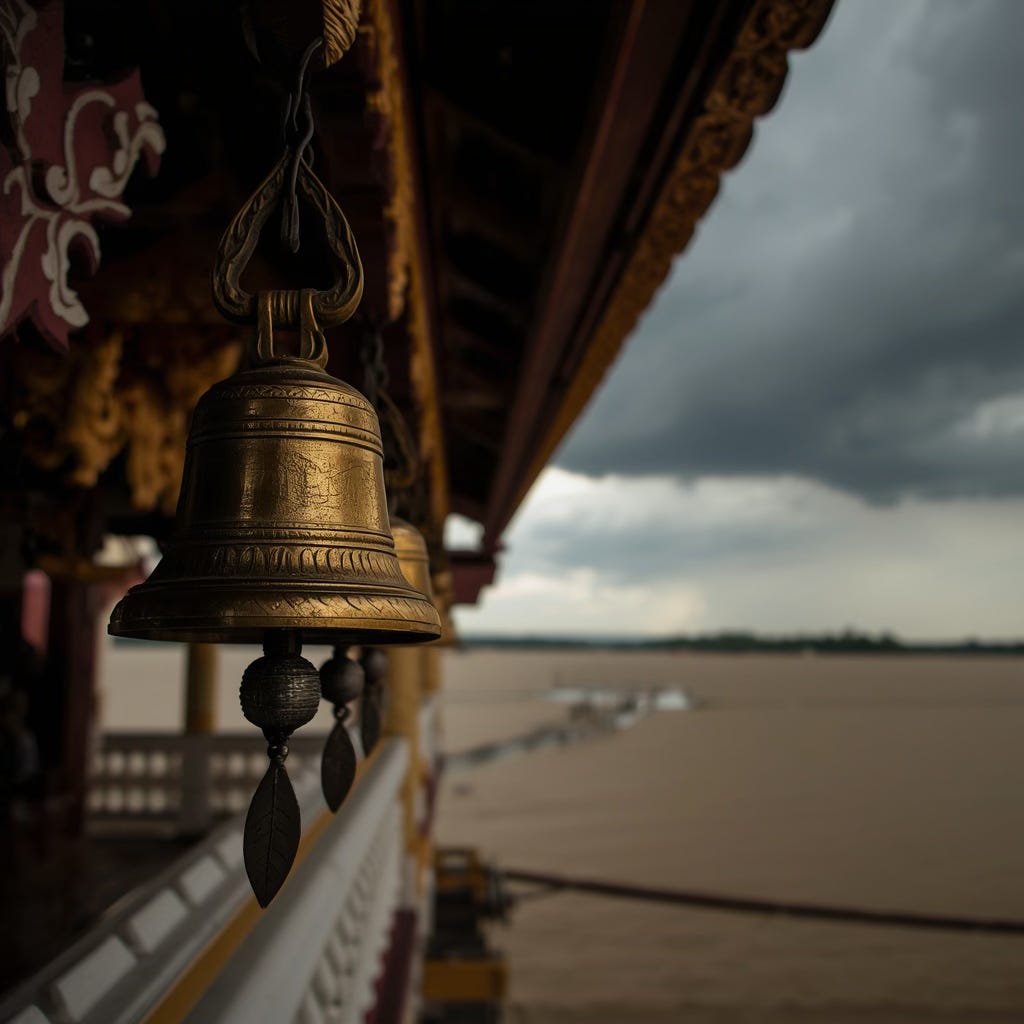
As the Abbot prepared to leave the platform, the wind picked up. A row of small bells under the eaves, each with a clapper shaped like a Bodhi leaf came to life. The wind had caught the leaves, gently ringing the bells. Lazily at first, then quicker, until the tingling of the bells merged with the saxophone. The Abbot listened. Reaching down, he picked up a bag of rice, flung it over one shoulder and disappeared inside. Jai continued to play as the last light glittered off the bells. When the Abbot reappeared on the platform, Jai having leaned his saxophone against the railing, held the gas cylinder with both hands. The Abbot stepped aside as the novice carried the canister inside. The darkening sky promised more rain. The boats had gone. The bells had just begun to ring.
Moore's stories always leave me with a feeling that i understand, however vaguely, something about a culture that mystifies me. writing that in a language of a culture so different there are no word to explain, is a true talent.