


The Coolness of Yai Phueng
A short story
Christopher G. Moore
The fan in the corner turned the heat from one side of the room to the other and gave it back. Tin roof. A square of hard light lay on the floor like a hot coin. Yai Phueng sat on her low stool and did not move. The cloth on her neck had been damp an hour ago. It was dry now. She had lived through many hot seasons. This one sat on her chest and would not get off.
Film watched her from the doorway. School shirt, a bag of books on his shoulder. He was eighteen and named for a great fighter. This week he had seen old people from the lane carried out between two neighbours, their feet dragging.
“Come, Yai. We are going somewhere cool.”
The lane was worse than the room. The walls held the heat all day and radiated it back as a blow-torch at anyone who passed. Dogs lay flat, ribcages moving, in the shade of a cart. A vendor fanned herself with a foam plate and waited for buyers who didn’t arrive. He walked slowly beside his grandmother, his left arm under hers. She was light. He was frightened by how light. A wisp of flesh with a bird-like skeleton. They crossed to the wide road where the city buses ran. On the other side, a glass and chrome tower of the mall stood, catching the sunlight.
The automatic doors at the entrance opened, and the cold came out to meet them like a winter breeze. A few steps inside, Yai Phueng stopped. Her shortness of breath, pale face, and sweat on her forehead signalled she’d had no energy to move on. She glanced at the window displays of the shops. Marble and glass with mannequins dressed in winter coats. She inhaled the smell of fresh-brewed coffee. Her tongue touching her upper lip. She stared at trendy clothes that people with money could afford. She had passed this building a thousand times. Today was the first time she had the courage to go inside. And wouldn’t have dared this time but for the insistence of her grandson.
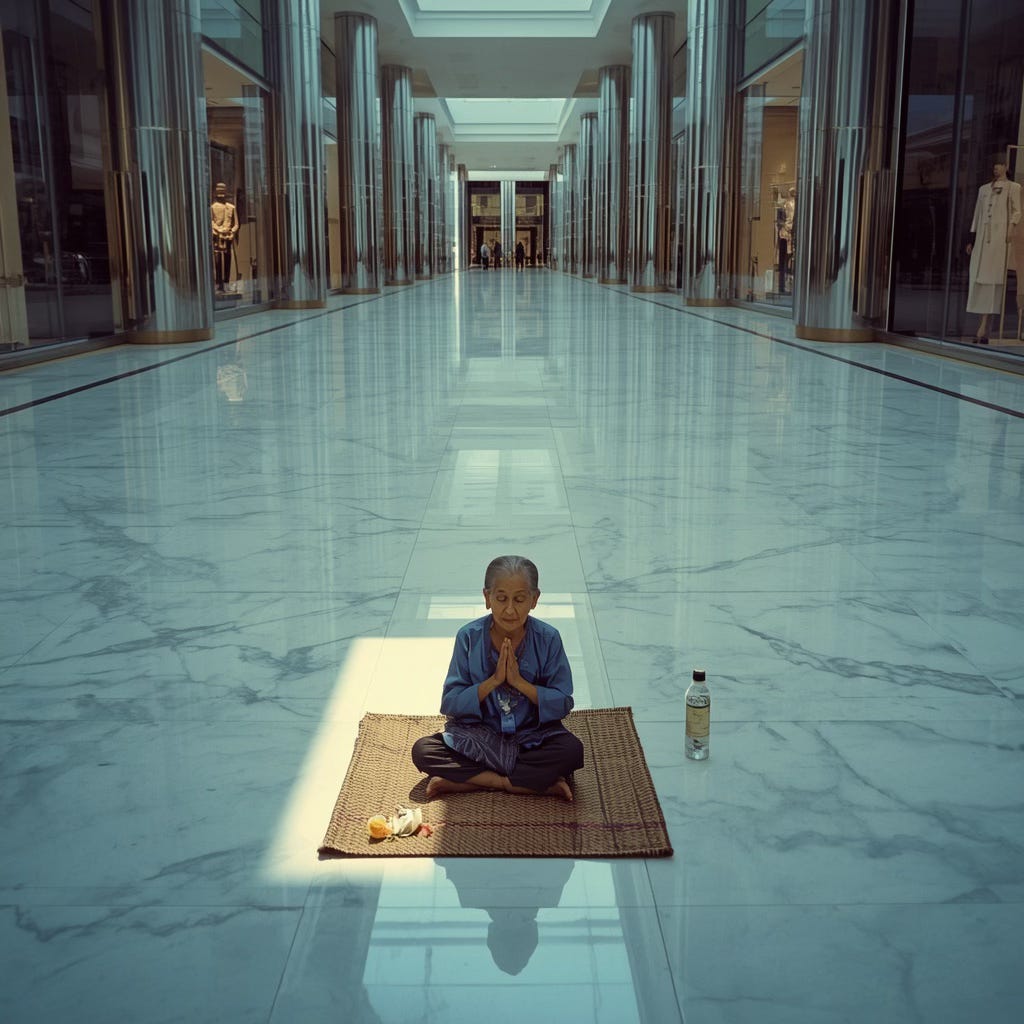
Her grandson, nicknamed Film, found a bench beside a quiet wall. After he settled her, Film went off, returning a few minutes later with a bamboo mat rolled under his arm. He unrolled it on the polished white marble, a small brown rectangle with flowers and a bird woven into a traditional Isaan village. He gestured for her to move from the bench to the mat. In this palace of cold the old ways of sitting had vanished.
“Rest. Two hours, Yai. Then we go home.”
She sat on the mat and closed her eyes and softly chanted a Sutra, her hands in wai. After the passage of two hours, she had curled up and was dreaming when Film touched her shoulder. She opened her eyes, smiling, but made no effort to get up.
“I am staying,” she said.
“You can’t stay. They won’t allow it.”
“I will be quiet. They won’t notice me.”
She gathered a bottle of water, comb and prayer beads in her cloth bag.
“Help me up,” she asked.
Film smiled until she moved down the corridor away from the door. She had her own mind. In a passage leading to the restrooms, she found a spot behind a pillar where the camera eye was blind.
“You can go now,” she said.
“Yai, you can’t.”
She smiled. “Of course, I can. Am I bothering anyone?”
That night she slept in the cold for the first time in her life.
In the morning she awoke on the mat, looking around, thinking she was dreaming. That feeling faded into a feeling as though she had always been there. A cleaning woman emerged from the Ladies restroom. She set a cold bottle of water down beside the mat. She waied Yai Phueng.
“You remind me of my grandmother in Nong Khai,” she said. “I saw you sleeping. Are you okay?”
“I am fine, child,” said Yai Phueng.
An hour later a young student working at the food court brought her a plate of khao man gai and folded two hundred baht into her hand.
“I’m not a beggar,” she said, holding the two notes out to him.
He sighed, stared at the notes, and slipped them back into his pocket. He wanted to say something, but waied her instead. Yai Phueng pressed her palms together and bowed her head. In the lanes of Klong Toey where she came from, you fed the old woman on the mat. You did not ask whose she was. You didn’t need to ask whether she was hungry. You knew.
Half an hour later, Khun Wang, a mall security guard, arrived. He came and stood over her and tapped his watch. Like the restroom attendant and the food court boy, he was from a village in the north and had a grandmother there he had not seen in two years.
“Grandmother. You slept here?”
She nodded.
“That isn’t allowed. You must go home.”
She said nothing, her eyes meeting his.
“Okay, one hour, and then you go.”
He looked at her a moment longer than the words needed. Then he went back to his post.
Her next visitor, later in the afternoon, was Khun Jira, who came in high heels, expensive shoes, a tailored suit with perfect makeup. She was from management. The word of an overnight visitor had reached the manager level. The building had rules, she explained. She held out a white envelope.
“For your trouble, Yai. Five thousand baht.”
Yai Phueng opened it, looked inside, and held it back out to her.
“What if I make it ten?” Jira asked.
The old woman looked up at Jira. “I’m not a beggar,” she said. Her tone of voice was soft, tender. She met Yai Phueng’s eyes. They displayed something like pity, as if Jira were the one who had lost touch of something vital. Jira set the envelope down on the mat.
In Thailand, such avoidance had a standard method: buy time. “One hour. Then I will have to call the police.”
The white envelope lay on the bamboo mat. “Wait, you forgot this,” said Yai.
Jira turned around, her mind flooded with indecision. She walked back and reached for the envelope.
“Please send it to your mother,” said Yai.
Jira said nothing and left Yai holding the envelope.
Film returned from school with his books in a backpack strapped to his back. He saw the white envelope, opened it and took out the money.
“What is this?” he asked, looking up.
“No, it’s not for my vote in an election. It’s for me to leave.”
“Five thousand baht, of course you will leave.”
“You don’t understand, my child.”
The airless room waited for her at home. The fan fought the temperature and lost. He also understood that her staying wouldn’t end well. Yai was determined, and when she made up her mind that was pretty much it. He stood in the cold shopping mall air with his fists closed. His frustration built. He turned, once, all the way around, and there was nothing in the whole bright palace for him to swing at.
The next day Khun Jira returned to reason with her again. Rather than a white envelope she brought a dozen red roses in a vase and a plate of pineapple and orange slices. Jira registered that something had changed. Yai Phueng was no longer alone. Three other old women sat in a row, each on her own mat, hands folded, looking at nothing. Word had gone back along the lanes at Klong Toey the day before. None of the elderly newcomers were in good shape. The shoppers stepped around them on their way to the restroom. A woman in good clothes lifted her phone, and then another, and a third found a security guard to complain about Isaan beggars harassing women using the restroom. The guard knew this was a lie. Jira had briefed all the guards earlier that morning.
The spontaneous gatherings of the old and sick from the slums had entered other places. On the cold floor of the train station the old men sat with their backs to the wall. In a mall across the river, the same. Without a word passed between them, without anyone to lead, the old of the city had gone looking for the cold and had found where it was kept.
A day later, a television crew found Yai Phueng. The reporter crouched down to her level and held out the microphone.
“What is your plan, Yai?”
The old woman almost smiled.
“Is it wrong for a grandmother to want this?” She breathed in the cool air and slowly exhaled. “Have you forgotten Nam Jai? Isn’t that who we are?”
Officer Pun came with two officers to clear the area. He was young. Mid-twenties. He went down the row of old women on their mats, and at the fourth he stopped. Her hands were his grandmother’s hands, the same cords under the same skin. He stood a long moment over her. He told his men to wait.
The officials came, and the people from the NGOs, and bloggers with cameras. Khun Jira stood to one side and watched the woman she had tried to buy. Something crossed her face and went still. Then she walked out across the floor, and the heels rang on the marble floor the way they had the day she came with the envelope, the same sound exactly. She knelt on the bamboo mat. She put her arms around the old woman from the slum and held on. Yai Phueng’s hand came up, slow, and rested on the younger woman’s back. The cameras found the two of them there on the mat on the cold floor, and the mall went on selling around them. No one said the word. Everyone in the building knew it.
They reached an arrangement in the end. A corner near the side doors, set aside and kept cold, for the old who had nowhere cool to go. People wrote their names on a list to look after a grandmother who was not their own.
That evening Yai Phueng ate half her chicken rice and wrapped the other half in paper, folding the corners careful and tight.
“For the boy,” she told the woman beside her. “He is still growing.”
She lay down on the mat, in the cold she had fought to keep.
Film came in the morning with his books. The folded packet was beside her, where she had left it. He said her name. He knelt. He did not cry out. He picked up the small paper packet she had folded for him and held it in both hands.
Around him the mall opened for the day. A shutter rattled up. The coffee machine hissed and spat. A child ran past laughing. A cleaner set a cold bottle of water down by the mat out of old habit and moved on.
By the side doors, in the corner they kept cold, an old man was already awake on a fresh mat. The morning light came through the glass and lay along the floor in one long bright line. He looked at it a while. Then he stepped over it, careful, and went to sit where the cold was kept.
Very touching anf thought provoking
.Mahalo Chris.
Yet again, you have captured the Thai jai