


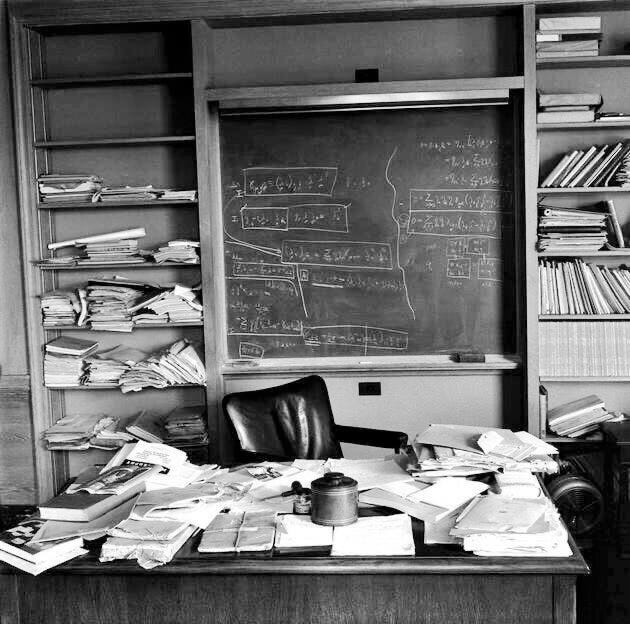
Study the photograph of Einstein’s office taken the day he died. Papers everywhere. A full chalkboard. Books open and stacked on books. From the outside it looks like a mess, chaotic and unstructured. From the inside it is the opposite. Like a living cell, it is many systems at work at once, each one relying on the others being present. That desk is what AI wants to organise. It wants to tidy the pile and throw out whatever looks irrelevant. Imagine doing that to a cell.
I have not seen a definition of AI slop that holds. Like consciousness, the word has spawned theories and disagreement, and I will not settle it here. But in the case of writing I can name what the machine does to a human page. It sterilises, and it compresses. Sterilisation removes whatever varies from the norm, the quirk and the odd turn and the word no one else would use. Compression drops the shadings that hold a meaning in its place. Two motions, one direction. Both pull your prose toward the average, because the average is the only place the machine is sure of. Einstein’s desk is human slop, and slop is the name the average gives to everything it cannot file.
Sterilisation happens in an operating theatre. You load your prose into the chat box. You have wheeled it in yourself. The surgeon is a set of algorithms trained to find the parts that vary most from the norm and cut them out. What is you in the prose comes out like a growth. You are shown the result and told you have a clean bill of health.
The patient on that table is not unconscious. I got that wrong for years, and it is the thing that matters most. A real patient surrenders control when the anaesthetic takes hold. You never have to. You can stay awake from the first cut to the last. You can tell the surgeon exactly what to do. Then hand him a longer list of things he would reach for on his own, and forbid every one. I have written that list. Most people never do. They stay conscious but never mindful, mistake the clean result for a recovery, and do not feel the harm until it is theirs.
Do not take my word for any of this. Watch it work. I gave the machine four passages by writers who are past objecting. It was in its ordinary state. I asked it to do the helpful things people ask for every day. Tighten this. Clean up the run-on. Reduce the repetition. Modernise the language. Make it land. What came back is below, beside what went in.
Dickens built a whole government office out of repetition. In Little Dorrit the Circumlocution Office defends itself, and the sentence performs the defence:
Then would the noble lord, or right honourable gentleman, in whose department it was to defend the Circumlocution Office, put an orange in his pocket, and make a regular fieldday of the occasion. Then would he come down to that house with a slap upon the table. The Circumlocution Office not only was blameless in this matter, but was commendable in this matter, was extollable to the skies in this matter.
Ask the machine to reduce the repetition, and it obliges:
The minister responsible for defending the office would then rise theatrically in the House, confront his questioner, and insist the office was not merely blameless but positively commendable.
Clearer. Also dead. The three hammer-blows of “Then would he” were the joke. The office is a machine for saying nothing at great length. Dickens wrote a sentence that says little at great length, so you feel the thing before you name it. That sentence is an Einstein’s desk. The repetition looks like clutter to the tidying eye. It is a working system. Clear the desk and the satire goes in the bin with the orange.
Thomas Mann buried a hallucination inside a single fevered sentence. Aschenbach, pausing on a walk, is ambushed by a vision:
He saw. He saw a landscape, a tropical quagmire beneath a steamy sky, sultry, luxuriant, and monstrous, a kind of primordial wilderness of islands, marshes, and alluvial channels; saw hairy palm shafts thrusting upward, near and far, from rank clusters of bracken.
Ask the machine to fix the run-on, and it tidies the desk:
His imagination conjured a vivid scene. He saw a tropical landscape beneath a steamy sky: a primordial wilderness of islands, marshes, and channels, where hairy palms rose from dense clusters of ferns.
Every fact survives. The fever does not. The delirium lived in the pile, in the saw and saw and saw again, in the semicolon that refuses to stop, in “sultry, luxuriant, and monstrous” arriving before you were ready. The machine read the pile as mess and filed it into order. The scenery is intact. The experience of the scenery is gone. That is compression doing exactly what it promises. The appearance of the meaning, and none of its weight.
Goethe’s devil describes God’s favourite creature in four rhymed lines. This is Bayard Taylor’s translation, cut to fit the German metre:
Saving Thy Gracious Presence, he to me / A long-legged grasshopper appears to be, / That springing flies, and flying springs, / And in the grass the same old ditty sings.
Ask the machine to modernise it, and it helps:
With respect, he strikes me as a kind of long-legged grasshopper, forever hopping and flitting about, singing the same old tune in the grass.
The rhyme is gone. So is the verse. So is “springing flies, and flying springs,” which the machine read as one idea said twice and rewrote as hopping and flitting about. It was not one idea said twice. It was the grasshopper’s motion built into the grammar, the springing turning into flying and back inside a single mirrored line. The device and the redundancy look identical from the outside. Only a reader who knows what the line is doing can tell them apart, and the default is not that reader.
Then the reverse, because the pull to the mean does not only cut. Six words, long pinned on Hemingway and almost certainly not his, though the economy is his kind:
For sale: baby shoes, never worn.
Ask the machine to expand it, to give it some impact, and it cannot help itself:
For sale: a pair of baby shoes, never worn — a small, heartbreaking reminder of a hope that never arrived, now looking for a home where they will finally be loved.
The whole story lived in the gap. The reader stepped into it and supplied the grief, which is why the grief landed. The machine could not bear the gap. It filled it, named the heartbreak, and reached, unprompted, for the em-dash this essay refuses to use. Same force as the others, running the other way. The florid gets shaved toward the mean. The spare gets padded up to it. The average has a length, and everything is dragged to that length.
Nobody is going to edit Dickens. That is not the danger. The danger is that the same motion runs on your email, your notes, your posts. There it is invisible, because your voice is not loud enough to make the loss show. The exception is the non-native speaker. If English is not your native language, your emails may suddenly read in a voice that is clearly not your own. Dickens and Mann and Goethe are the contrast dye. They make visible a movement that happens to your own prose every day without a mark on the surface.
Where does the pull come from? Not from nowhere, and not from a hand on the wheel. The word for it is older than the machine. Alexei Yurchak coined hypernormalisation for the last Soviet years. Everyone knew the system was hollow. Everyone kept performing it as though it were permanent, until the performance was the only reality left. Adam Curtis borrowed the word for his 2016 film of the same name and turned it on us. Complexity is swapped for a simpler, faker copy of itself, and we lose the power to question the swap. We are absorbed into the fake reality because we cannot imagine another to replace it.
AI is a new engine for that old process, and it needs no conspiracy to run. It was programmed to run on the average. Its default voice is the mean of everything it was trained on. The mean is its makers’ norms, because the machine holds no principles of its own. At this stage, in 2026, how could it be otherwise? Claude is a human construct. It carries the values of the people who built it. Left to the default it will sterilise and compress, because that is the digital culture it was raised inside. The dream-world needs no driver. It runs on default settings, because most users never change them.
That is the whole point. AI slop is like dying intestate. Leave no will and the law hands out your estate by a formula you never chose and might have hated. Give the machine no constraints and it hands out your voice the same way, by a default you never picked. When you read what comes back and feel that something is wrong but cannot name it, this is the feeling. Leaving the machine unconstrained is not a crime. It is a decision, and the machine answers that decision with template prose, a polished piece that gives a generic answer to a generic question. The instructions were yours to leave.
So do not point at the machine. Point at yourself. You have agency. The machine quietly works inside built-in constraints, and when you fail to supply your rules, it automatically applies the standard template. You can choose to write your own will. If you fail to do so, a template is automatically applied to your estate. That’s also how AI works.
Einstein decided how to arrange his desk and blackboard. He never tidied the desk into a clean surface that reflected the light with an alluring sparkle. The clutter was his decision. It was how he worked. The choice in front of every writer is the same one. Keep the desk untidy, with its living systems that an outsider would see as a mess. Or clean surface of the desk, wipe the blackboard to gain an Instagram look of elegance and legibility. You’ve created a room that belongs to no one. An AI will clean up what it perceives as debris and clutter. When that happens, part of you disappears. Your writing is like the clean code that delivered what your unconstrained query asked for. Beware: if your room is too clean, the shiny, polished surface all but writes, in the spirit of Kilroy, “I was here.”