

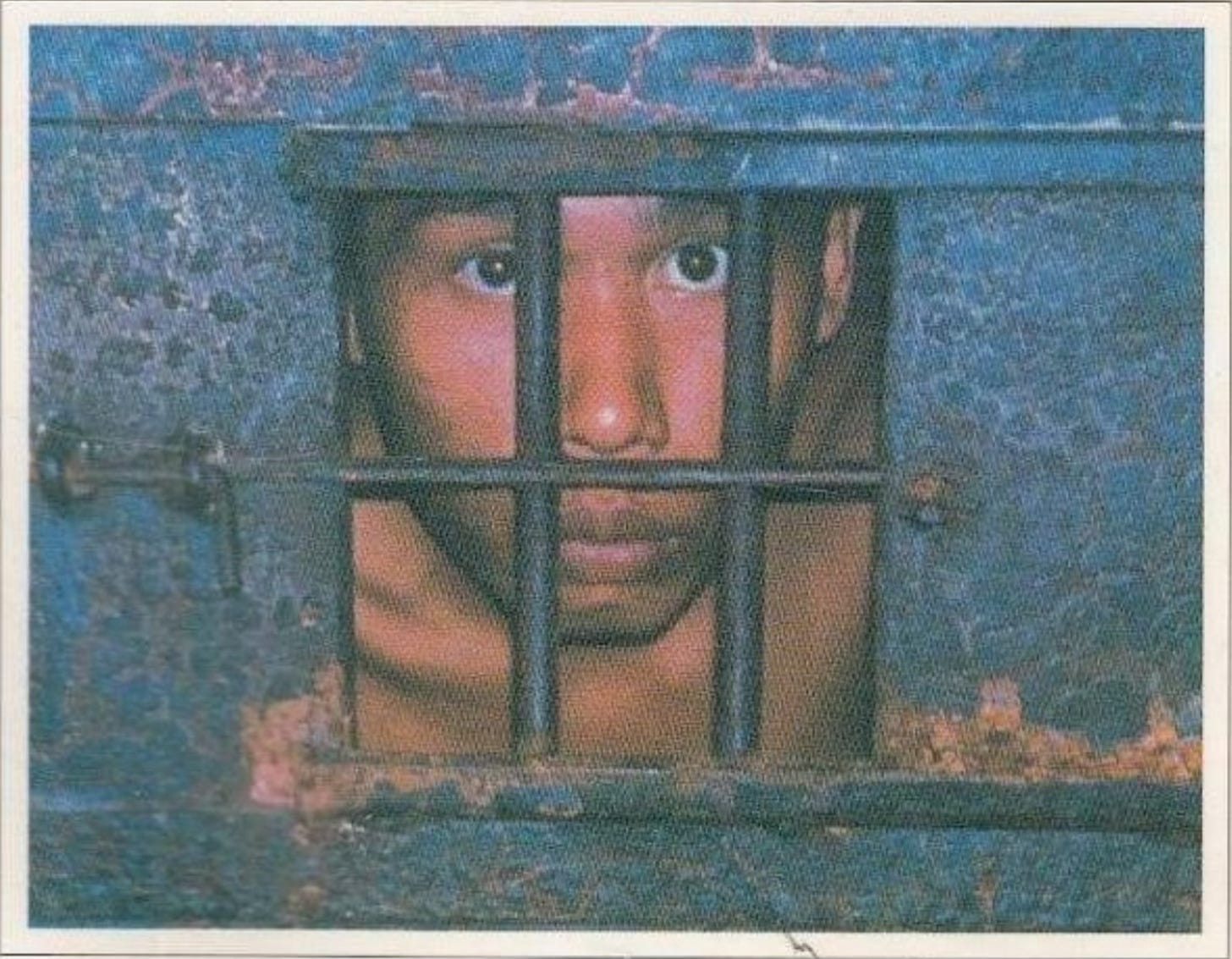
T3 Prison, Phnom Penh, 1993. © Christopher G. Moore.
The April heat in Phnom Penh drained energy. We moved slowly toward the main gate entrance to T3 prison. Three of us walked side by side. As an accredited journalist, I had been assigned to work with two members of UNTAC. Ian, tall, slim, close-cropped black hair, reminded me of Jack Power. The copper in Ulysses. Jack helped Leopold Bloom escape a confrontation in a pub. The connection happened after Ian’s random reference to Ulysses. Irish storytellers also wore police uniforms. Ian had woven Jack Power into our conversation on the way to T3. Ian’s face was a cross between James Joyce and George Orwell. He wore the same policeman’s uniform when he patrolled the streets of Dublin. Face and dress unmistakably Irish matching his accent.
Ian’s partner was from KL. Mat Botak, a nickname that translated as Bald Mat.
Mat wore his KL police force uniform.
“In case you need to escape, I’ll be there,” Ian had said. Ian exchanged a grin with Mat.
Mat said, “The last reporter we took inside T3 is missing.”
“Yeah, that guy from New York. I wonder what happened to him,” said Ian.
“Ronnie. His last name I forget.” Removing his hat, and wiping the sweat off his bald head.
“You made an appointment?” I asked, looking first at Ian and then at Mat.
“I’m trying to imagine how appointments work in a war zone,” said Ian.
“UNTAC is what is organised when appointments become impossible,” said Mat.
And me? I was dressed in blue jeans and a T-shirt. The clothing that appeared thousands of times as the police sought to identify a victim. How you dressed announced your authority. All I had was my official press card on a string around my neck. My UNTAC escorts had apparently cast me in the role of Leopold Bloom. And winding me up on the way inside.
T3 was no Dublin pub. It was one of Southeast Asia’s colonial relics. A shrine to repression, terror and punishment. Ian carried a bottle of Johnnie Walker Red Label he’d bought at the PX. I asked Ian about the bottle. “It’s a door opener,” he said.
As the main medieval gate opened for us, a Cambodian prison official greeted us. Ian introduced us and handed the officer the bottle of Johnnie Walker. The official had the relaxed, joyful personality of a tour guide. The gate shut behind us and the official guided us through a courtyard. Women sat on the ground near a small garden. A couple of the women tended the tomato and bean plants, all of which had suffered from lack of water. It was a small community. The officer said they were prisoners. A pale woman lay motionless on a hammock strung between two trees. I’m not certain what I expected inside T3, but a community of women, a garden, and an ill woman weren’t on my dance card. I asked the officer about the woman in the hammock. “She has TB. May be she live another week. May be not.”
He delivered the verdict as a judge announcing a death sentence.
“Does she have medicine?” It was a futile question.
The officer shrugged. “Not so much medicine in Cambodia.”
Ian said, “There’s medicine. But not everyone receiving it.” Then he whispered something to the officer, who nodded.
We followed behind the Cambodian officer, who was clutching the bottle of whiskey. I’d been living in Bangkok long enough to read that a setup was unfolding. That the Johnnie Walker gift was going to be repaid.
Along with Mat Botak, Ian had a mission, one that I was ready to be read in. We rounded a corridor and stopped in front of an iron door with bars on a small window. The officer set the bottle down, fumbled a key chain, and finding the right key, inserted it into the lock. The door swung open. He stood to one side and waved us into the “room”. I use scare quotes around room because it was rough concrete: ceiling, walls, and floor. A dozen young Khmer men stripped to their underpants sat in two rows facing one another in the dark. The light from the open door blinded them. Heads turned up, they blinked as if waking from a bad dream. Their legs were bolted to the floor with heavy iron ankle shackles. The thick bar ran between the two sides of men, facing one another.
A wave of dank smell, sweat and urine stink mixed, creating its own fetid weather. The bodies sat motionless in the stillness of the darkness. Warehoused in a cell built during the colonial era, the boys in leg-irons chained to metal rod bolted to the floor. The stench made me gag. I couldn’t swallow it or spit it out. The hot burn of bile drained down my throat. The boys stared up at a foreigner pointing a camera at them, clearing his throat.
“My friend wants to take pictures,” Ian said.
“Wait,” said the Cambodian official. In the dark, he unlocked some of the shackles, keeping an eye on his bottle of Johnnie Walker. He rose, proud of his work. “Go ahead.”
I raised my camera, removed the cap from the lens and edged closer, photographing the rows of prisoners. Through the lens finder I found a sea of eyes staring back. How does a photo do justice to men’s eyes condemned to darkness, the dampness seeping into their young bodies. I looked up. They were just kids. They should be in school. Playing sports. Laughing and jostling each other. Childhood was nowhere to be found inside the room. How did I know this? I sensed it from the complete silence. Children are noisy. I didn’t hear a whimper. When a sound broke that spell, I turned to see that the Cambodian officer stood to my left, rattling his chain of keys, glancing over his shoulder. The officer had overlooked several of the boys whose shackles remained in place. I stepped back, and took several more photos. He was distracted, worried that someone would walk down the corridor, see the open door to the cell, report what was going on with these foreigners. Our time inside was no more than 10 minutes. Time seemed to stop. The scene frozen on film, and in the reality of the cell. I had on film the evidence I needed.
On the way out the cell, the officer closed and locked the door. As we were about to leave, I turned and saw the young boys’ faces, staring at us between the bars on the small window. The officer hadn’t bothered to put them back in shackles. For a moment, they tasted freedom. I snapped a picture of those boys framed in the window. You can find it at the beginning of this story.
I understood why Ian had planned for an “escape” option. The question was whether one bottle of Johnnie Walker was going to cover the situation. The Cambodian officer continued to smile. It was one of those rare times when I witnessed first-hand how violence was normalised. The dying woman in the courtyard, the two facing rows of young men shackled to the floor. In his world, this was the reality of life. It was ordinary. Accepted. Routine. I had a lens between me and their faces. That asymmetry of camera to subject had never been so stark. A camera makes one person a voyeur, walling you off from the person on the other side of the lens. I lowered the camera, walked ahead.
The Cambodian officer barked an order. “That’s far enough.”
I stopped, trying to make eye contact with as many of the boys as I could. For a moment, there was a human connection. I’d seen those faces before. In New York City, as a civilian observer riding with NYPD, in what were then some very dangerous neighbourhoods of Brooklyn. Faces emptied of hope. Men’s eyes staring into the void. Wondering if this person standing tall with his camera can help me escape.
On our way back to UNTAC HQ for a press briefing, none of us spoke. Ian and Mat Botak searched for words, for a joke, for anything to hold onto as a way to distract the feelings arising from what we’d witnessed. When a cop goes quiet, it was a signpost that was difficult to read.
Back at HQ, we sat down together. “The authorities are lying. They swore up and down that they weren’t shackling prisoners,” said Ian.
Mat Botak removed his cap, shaking his head. “The UN inspected and found no shackles. They gave T3 a clean bill of health.”
“They made an appointment,” said Ian.
Ian rose from the chair. “Those boys are left to rot. It’s not right. Use those photos and tell the story about what you saw.”
The peacekeepers wanted more than peace. They wanted justice.
I had an appointment with a UN official on the day of my return flight to Bangkok. I walked into the office of a young UN official, a fellow Canadian from Ontario, and told him what I’d seen at T3. I told him I had it on film. He refused to believe me. He’d filed a report a week before confirming that the Cambodian authorities were in compliance with the order not to shackle prisoners. And I was making trouble. He was firm and showed me to the door. That was when I felt the most hopeless, not inside the cell, not looking at the boys, but in the office of a UN official who had the power to do something. He had refused to accept an eyewitness account. Consequences would follow if he reported the violation. The appointment was over. I stood outside waiting. Breathing the hot air. Knowing that I carried a burden and it would stay with me for a lifetime.
Later, in Bangkok, I sent the negatives to a bureau in New York City which sent them to Newsweek. The photos were scheduled to run only to be replaced by a breaking celebrity scandal. The negatives were never returned. An obscure magazine for lawyers that I was stringing for ran the photos along with my story. Maybe a couple of hundred people saw them.
Appointment or no appointment hadn’t changed the story the world knew about T3. A story I tried to tell in Zero Hour in Phnom Penh. The first edition of that novel was called Cut Out and ran with a photo taken that day in T3.
In the age of the Internet, the zone is flooded with photos of mangled bodies, victims of genocide, destroyed lives, houses, schools, hospitals and shopping malls. Looking back at that afternoon inside T3, I had the youthful belief that people would feel something if they saw the condition of those young men. Something would be done. An attempt at righting the wrong would gain public support.
As a novelist, at some stage, you begin to understand what lies in the dark room of noir. You are fooling yourself if you think an appointment will change a destiny that isn’t in your control or one that you fully understand. You can photograph suffering but you can’t stop the pain. It is the moment of feeling helpless. That any gesture is a futile act of performance. Those boys taught me to feel something about how boys are broken, how power wears a smile, and why appointments are instruments of the power game. From jailer to UN officials, appointments and meetings were the medium to decide whether a leg-iron remains locked or unlocked.
Writing this story, the stench of the T3 cell swelled up in the back of my throat. Memory is that uninvited guest who you thought had left long ago. For a moment, I was back, inside a dark, airless room, swallowing hard, trying not to gag, and snapping photographs.